Diagnóstico de Diabetes Mellitus tipo 2: exploración hermenéutica del impacto en personas adultas y mayores
Barra lateral del artículo
Contenido principal del artículo
Resumen
Introducción: la manera en que se afronta el diagnóstico de una enfermedad crónica está condicionada por significados y valoraciones construidos en el curso de vida.
Objetivo: explorar en la interpretación hermenéutica del impacto del diagnóstico de Diabetes Mellitus tipo 2 (DM2), sobre las vivencias experimentadas, los desafíos enfrentados y los patrones alimentarios relatados por adultos y personas mayores.
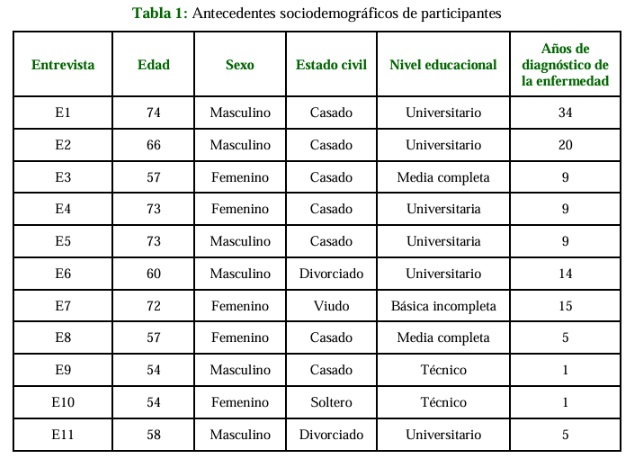
Metodología: estudio cualitativo de enfoque fenomenológico hermenéutico y alcance exploratorio. Participaron adultos y personas mayores con diagnóstico de DM2. Se utilizó un muestreo cualitativo por conveniencia según saturación de significados. La recolección de datos fue realizada a través de entrevista semiestructurada y la metodología de análisis fue temático reflexivo de Braun y Clarke. Para el logro de una riqueza interpretativa y validez a los hallazgos se realizó triangulación de investigadores. El estudio contó con la aprobación de comité de ética.
Resultados: la percepción del impacto del diagnóstico en las vivencias y los patrones alimentarios permite reconocer una respuesta individual que se basa en la personalidad y el contexto sociocultural. La alimentación, como una de las bases del tratamiento no farmacológico, es comprendida como relevante, pero la continuidad en el tiempo complejiza una gestión adecuada de la enfermedad y sus cuidados.
Conclusiones: el diagnóstico DM2 influye en los significados e interpretaciones que las personas asignaron a su experiencia y comprendieron sus desafíos. Los patrones alimentarios son adaptados, replanteados o mantenidos según las experiencias y circunstancias individuales.
Detalles del artículo

Esta obra está bajo una licencia internacional Creative Commons Atribución 4.0.
Usted es libre de:
- Compartir: copiar y redistribuir el material en cualquier medio o formato para cualquier propósito, incluso comercialmente.
- Adaptar: remezclar, transformar y construir a partir del material para cualquier propósito, incluso comercialmente.
- La licenciante no puede revocar estas libertades en tanto usted siga los términos de la licencia
Bajo los siguientes términos:
- Atribución: Usted debe dar crédito de manera adecuada, brindar un enlace a la licencia, e indicar si se han realizado cambios. Puede hacerlo en cualquier forma razonable, pero no de forma tal que sugiera que usted o su uso tienen el apoyo de la licenciante.
- Compartir igual: — Si remezcla, transforma o crea a partir del material, debe distribuir su contribución bajo la misma licencia del original.
- No hay restricciones adicionales — No puede aplicar términos legales ni medidas tecnológicas que restrinjan legalmente a otras a hacer cualquier uso permitido por la licencia.
Citas
Nielsen MH, Jensen AL, Pedersen ML, Seibæk L. Living with chronic obstructive pulmonary disease or type 2 diabetes in Greenland - a qualitative interpretive description study. Int J Circumpolar Health. 2024; 83(1):2296706. doi: 10.1080/22423982.2023.2296706.
Giuseppe MD, Spatola C, Merlo EM, Silvestro O, Giorgianni CM, Juli G, Catalano A, Martino G. Research Advances in Clinical Psychology of Chronic Diseases. Psychiatr Danub. 2025;37(Suppl 1):56-62.
Sharpe L, Michalowski M, Richmond B, Menzies RE, Shaw J. Fear of progression in chronic illnesses other than cancer: a systematic review and meta-analysis of a transdiagnostic construct. Health Psychol Rev. 2023; 17(2):301-320. doi: 10.1080/17437199.2022.2039744.
GBD 2021 Diabetes Collaborators. Global, regional, and national burden of diabetes from 1990 to 2021, with projections of prevalence to 2050: a systematic analysis for the Global Burden of Disease Study 2021. Lancet. 2023; 402(10397): 203-234. doi: 10.1016/S0140-6736(23)01301-6.
Tegegne BA, Adugna A, Yenet A, Yihunie Belay W, Yibeltal Y, Dagne A, HibstuTeffera Z, Amare GA, Abebaw D, Tewabe H, Abebe RB, Zeleke TK. A critical review on diabetes mellitus type 1 and type 2 management approaches: from lifestyle modification to current and novel targets and therapeutic agents. Front Endocrinol (Lausanne). 2024;15:1440456. doi: 10.3389/fendo.2024.1440456.
Romadlon DS, Tu YK, Chen YC, Hasan F, Kurniawan R, Chiu HY. Comparative Effects of Diabetes Self-Management Programs on Type 2 Diabetes Clinical Outcomes: A Systematic Review and Network Meta-Analysis. Diabetes Metab Res Rev. 2024; 40(6):e3840. doi: 10.1002/dmrr.3840.
Maina P, Pienaar M, Reid M. Self-management practices for preventing complications of type II diabetes mellitus in low and middle-income countries: A scoping review. Int J Nurs Stud Adv. 2023; 5:100136. doi: 10.1016/j.ijnsa.2023.100136.
Elesbão TN, Juzwiak CR. The diagnosis of celiac disease as a turning point in food choices and new foodways. Soc. Cult. 2024; 27: e77467. doi: 10.5216/sec.v27.77467.
Long T, Zhang Y, Wu Y, Xing P, Zhang Y, Li M. Food Choice Decision-Making Profiles and Health Outcomes in Adults with Type 2 Diabetes and Overweight/Obesity: A Cluster Analysis. Am J Health Promot. 2026;40(2):235-239. doi: 10.1177/08901171251371447.
Rodrigues ES, Bezerra ENC, Sousa LRB, Pereira IC, Monte ZLO, Macedo JL, et al. Factors that hinder adherence to nutritional therapy in individuals with type 2 diabetes mellitus: an integrative review. Rev Bras ObesNutrEmagrec. 2024; 18(112):143-51.
CasañaMohedo J, Murillo-Llorente MT, Palau Ferre A, Faus M, Gómez Taylor B, EsteveClaramunt F, Morales Palomares S, Sandri E. Nutritional Needs, Dietary Knowledge, and Culinary Skills in Individuals with Diabetes Mellitus: A Scoping Review. Adv Nutr. 2026; 17(5):100627. doi: 10.1016/j.advnut.2026.100627.
Puder J, Keller U. Quality of diabetes care: problem of patient or doctor adherence? Swiss Med Wkly. 2003; 133(39-40):530-534. doi: 10.4414/smw.2003.10290
Cheng Z, Xiao Q, Xu Y, Tan L, Qu W, Shen W, Luo Y. Effectiveness of patient-centred care in self-management of type 2 diabetes: a systematic review and meta-analysis. BMC Health Serv Res. 2025; 25(1):613. doi: 10.1186/s12913-025-12539-6.
Ades R, Evans J, Heath J. What does qualitative evidence tell us about how having a diagnosis of type 1 diabetes mellitus impacts an individual's identity? A systematic review. J Health Psychol. 2026;31(3):983-1000. doi: 10.1177/13591053251362032.
Mendoza G, Rodríguez Y, Domínguez C, Juárez-Medina L, Villa-Rueda A, González-Ramírez J, Gutiérrez-Valverde J. Personality Traits and Self-Care Behaviors in Adults with Type 2 Diabetes Mellitus. Diabetes MetabSyndrObes. 2022; 15:1-6. doi: 10.2147/DMSO.S340277
Mohamed S, Thomas A, Masnoddin M, Rumaling MI, Salag MSS. The Intersection of Ethnocultural Identity and Glycemic Management: A Qualitative Synthesis of Dietary Constructions Among Individuals with Uncontrolled Diabetes in Asia. Int Rev Multidiscip Res. 2026;1(9):337-350. doi:10.67167/vertex.692
Rigby R, Williams L, Mitchell L, Ball L, Hamilton K. Understanding dietary behaviour change after a diagnosis of diabetes: A qualitative investigation of adults with type 2 diabetes. PLoS One. 2022; 17(12): e0278984. doi: 10.1371/journal.pone.0278984
Bekken T, Ottesen N, Glenton C, Nordheim LV. What motivates people with type 2 diabetes to maintain lifestyle changes and what challenges do they experience? A qualitative evidence synthesis. PLoS One. 2025; 20(9): e0332276. doi: 10.1371/journal.pone.0332276.
McClinchy J, Dickinson A, Wills W. Do Peer Support Groups Facilitate Nutrition Information Practice and Nutritional Self-Management in People Living with Type 2 Diabetes? J Hum Nutr Diet. 2025; 38(6): e70158. doi: 10.1111/jhn.70158.
Bendixen BE, Wilhelmsen-Langeland A, Lomborg K, Måkestad E, Skogheim TL, Schønberg A, Iversen MM, Kvale G, Søfteland E, Haugstvedt A. Experiences with a Novel Micro-Choice-Based Concentrated Group Intervention for People with Type 2 Diabetes: A Qualitative Study. Sci Diabetes Self Manag Care. 2025; 51(1):36-46. doi: 10.1177/26350106241304422.
Unni EJ, Young C, Rath TJ, Beverly EA. Navigating a New Reality—Exploring Unmet Psychosocial Needs in Adults Newly Diagnosed with Type 2 Diabetes. Diabetes. 2025;74(Suppl 1):616-P. doi:10.2337/db25-616-P.
Demir Çam S, Uzun S. Disease burden and symptom management in type 2 diabetic patients: A phenomenological study. Public Health Nurs. 2024; 41(6): 1291-1301. doi: 10.1111/phn.13404.
Khazew HR, Faraj RK. Illness acceptance and its relationship to health-behaviors among patients with type 2 diabetes: A mediating role of self-hardiness. CurrProblCardiol. 2024; 49(8):102606. doi: 10.1016/j.cpcardiol.2024.102606
Al Mahrouqi AS, Mallinson RK, Oh KM, Weinstein AA. Patients; and Nurses; Perceptions of Diabetes Self-Management in Oman: A Qualitative Study. Int J Environ Res Public Health. 2022; 19(11):6929. doi: 10.3390/ijerph19116929.
Carlsund Å, Hörnsten Å, Hoosen F, Amoah S, Otten J. Supporting change in a complex reality: a qualitative study of specialist nurses' perceptions of counselling patients at risk of type 2 diabetes. Int J Nurs Stud Adv. 2026; 11: 100607. doi: 10.1016/j.ijnsa.2026.100607.
Buichia-Sombra FG, Guerrero-Castañeda RF, Lara-Ponce E. Experience of Living With Type 2 Diabetes in Adults: Systematic Review of Phenomenological Studies. Cult Cuid. 2024; (69): 47-66. doi:10.14198/cuid.22596.
Lekha PPS, Azeez EPA. Psychosocial Facilitators and Barriers to Type 2 Diabetes Management in Adults: A Meta-Synthesis. Curr Diabetes Rev. 2024;20(8):110-123. doi:10.2174/0115733998283436231207093250.
Neri L, da Silva E. Editorial: Health education and type 2 diabetes. Front. Nutr. 2023; 10:1325517. doi:10.3389/fnut.2023.1325517
Sarfo JO, Obeng P, Kyereh HK, Ansah EW, Attafuah PYA. Self-Determination Theory and Quality of Life of Adults with Diabetes: A Scoping Review. J Diabetes Res. 2023;2023:5341656. doi: 10.1155/2023/5341656.
Saeedian Y, Agarwal A, Jansons P, Fuller-Tyszkiewicz M, Maddison R. Self-determinationtheoryinterventions in self-careof cardiovascular disease: A systematicreview. PatientEducCouns. 2025;137:108794. doi: 10.1016/j.pec.2025.108794.