Traducción, adaptación cultural y validación psicométrica preliminar de la versión en español del Menstrual Distress Questionnaire (MEDI-Q)
Barra lateral del artículo
Contenido principal del artículo
Resumen
Introducción: El distrés menstrual puede afectar el bienestar psicológico, el funcionamiento cotidiano y el rendimiento académico de mujeres jóvenes. En América Latina existen pocos instrumentos validados en español para evaluarlo.
Objetivo: Traducir, adaptar culturalmente y evaluar preliminarmente las evidencias de validez y fiabilidad de la versión en español del MEDI-Q en estudiantes universitarias paraguayas, considerando su contenido, estructura interna y relación con variables externas.
Metodología: Estudio cuantitativo, transversal e instrumental con 216 estudiantes. La estructura interna se examinó mediante análisis factorial confirmatorio y la fiabilidad mediante alfa de Cronbach y omega de McDonald. Se analizaron asociaciones con ansiedad, depresión y ausentismo académico.
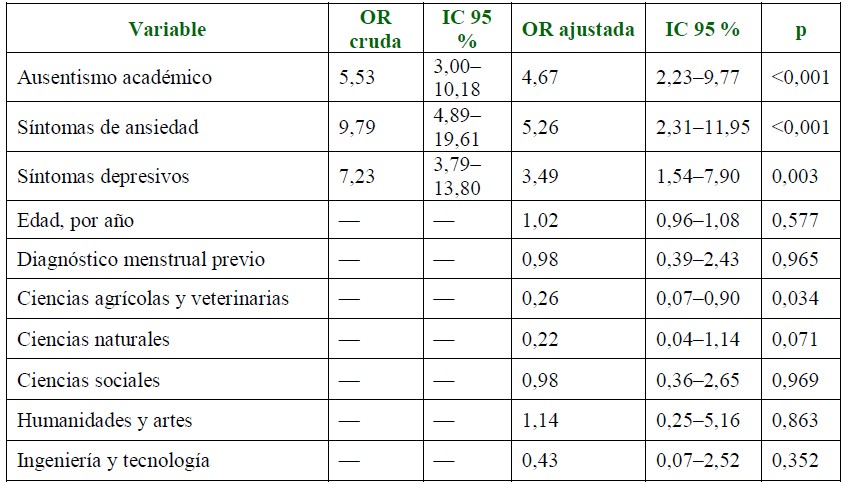
Resultados: La edad media fue de 24 ± 6,5 años. El MEDI-Q mostró elevada consistencia interna (α = 0,901; ω = 0,90). El modelo unidimensional no alcanzó los criterios preespecificados de ajuste aceptable: SRMR = 0,057; RMSEA = 0,088; CFI = 0,880; TLI = 0,860. En esta muestra autoseleccionada, el 65,7 % obtuvo puntuaciones ≥20. En el modelo multivariable, el ausentismo académico (ORa = 4,67; IC 95 %: 2,23–9,77), la ansiedad (ORa = 5,26; IC 95 %: 2,31–11,95) y la depresión (ORa = 3,49; IC 95 %: 1,54–7,90) permanecieron asociados con puntuaciones ≥20.
Conclusiones: La versión en español mostró elevada consistencia interna, pero evidencia limitada basada en su estructura interna. Las asociaciones fueron transversales e imprecisas y no permiten inferir causalidad, capacidad predictiva ni utilidad diagnóstica.
Detalles del artículo

Esta obra está bajo una licencia internacional Creative Commons Atribución 4.0.
Usted es libre de:
- Compartir: copiar y redistribuir el material en cualquier medio o formato para cualquier propósito, incluso comercialmente.
- Adaptar: remezclar, transformar y construir a partir del material para cualquier propósito, incluso comercialmente.
- La licenciante no puede revocar estas libertades en tanto usted siga los términos de la licencia
Bajo los siguientes términos:
- Atribución: Usted debe dar crédito de manera adecuada, brindar un enlace a la licencia, e indicar si se han realizado cambios. Puede hacerlo en cualquier forma razonable, pero no de forma tal que sugiera que usted o su uso tienen el apoyo de la licenciante.
- Compartir igual: — Si remezcla, transforma o crea a partir del material, debe distribuir su contribución bajo la misma licencia del original.
- No hay restricciones adicionales — No puede aplicar términos legales ni medidas tecnológicas que restrinjan legalmente a otras a hacer cualquier uso permitido por la licencia.
Citas
Hennegan J, Shannon AK, Rubli J, Schwab KJ, Melendez-Torres GJ. Women's and girls' experiences of menstruation in low- and middle-income countries: A systematic review and qualitative metasynthesis. PLoS Med. 2019;16(5):e1002803. doi: 10.1371/journal.pmed.1002803
Hennegan J, Winkler IT, Bobel C, Keiser D, Hampton J, Larsson G, et al. Menstrual health: a definition for policy, practice, and research. Sex Reprod Health Matters. 2021;29(1):1911618. doi: 10.1080/26410397.2021.1911618
Armour M, Parry K, Manohar N, Holmes K, Ferfolja T, Curry C, et al. The Prevalence and Academic Impact of Dysmenorrhea in 21,573 Young Women: A Systematic Review and MetaAnalysis. J Womens Health (Larchmt). 2019;28(8):1161-1171. doi: 10.1089/jwh.2018.7615
Schoep ME, Adang EMM, Maas JWM, De Bie B, Aarts JWM, Nieboer TE. Productivity loss dueto menstruation-related symptoms: a nationwide cross-sectional survey among 32 748 women. BMJ Open. 2019;9(6):e026186. doi: 10.1136/bmjopen-2018-026186
Bruinvels G, Burden R, Brown N, Richards T, Pedlar C. The prevalence and impact of heavy menstrual bleeding (Menorrhagia) in elite and non-elite athletes. PLoS One. 2016;11(2):e0149881. doi: 10.1371/journal.pone.0149881
Direkvand-Moghadam A, Sayehmiri K, Delpisheh A, Sattar K. Epidemiology of premenstrual syndrome (PMS)-a systematic review and meta-analysis study. J Clin Diagn Res. 2014;8(2):106-9. doi: 10.7860/JCDR/2014/8024.4021
Eisenlohr-Moul TA, Schmalenberger KM, Owens SA, Peters JR, Dawson DN, Girdler SS. Perimenstrual exacerbation of symptoms in borderline personality disorder: evidence from multilevel models and the Carolina Premenstrual Assessment Scoring System. Psychol Med. 2018;48(12):2085-2095. doi: 10.1017/S0033291718001253
Moos RH. The development of a menstrual distress questionnaire. Psychosom Med. 1968;30(6):853-67. doi: 10.1097/00006842-196811000-00006
Vannuccini S, Rossi E, Cassioli E, Cirone D, Castellini G, Ricca V, et al. Menstrual Distress Questionnaire (MEDI-Q): a new tool to assess menstruation-related distress. Reprod Biomed Online. 2021;43(6):1107-1116. doi: 10.1016/j.rbmo.2021.08.029
BiciciUluşahin S, Özkutlu Ö, Kafa N, Aytar A. Psychometric properties of the Turkish version of the Menstrual Distress Questionnaire. J Exerc Ther Rehabil. 2025;12(1):56-67. doi: 10.15437/jetr.1461574
Harzif AK, Ikhsan M, Puspawardani AR, Ummah N, Shadrina A, Putri AS, et al. Validation of the Indonesian version of the Menstrual Distress Questionnaire (MEDI-Q): A reliability study. Eur J Obstet Gynecol Reprod Biol. 2025;311:113996. doi: 10.1016/j.ejogrb.2025.113996
Quek TT, Tam WW, Tran BX, Zhang M, Zhang Z, Ho CS, et al. The Global Prevalence of Anxiety Among Medical Students: a meta-analysis. Int J Environ Res Public Health. 2019;16(15):2735. doi: 10.3390/ijerph16152735
Mao Y, Zhang N, Liu J, Zhu B, He R, Wang X. A systematic review of depression and anxiety in medical students in China. BMC Med Educ. 2019;19(1):327. doi: 10.1186/s12909-019-1744-2
Torales J, Barrios I, Ortiz Galeano I. Manual de metodología de la investigación: una introducción a la investigación científica en ciencias de la salud. Asunción: EFACIM; 2024.
Gosling SD, Vazire S, Srivastava S, John OP. Should we trust web-based studies? A comparative analysis of six preconceptions about internet questionnaires. Am Psychol. 2004;59(2):93-104. doi: 10.1037/0003-066X.59.2.93
Beaton DE, Bombardier C, Guillemin F, Ferraz MB. Guidelines for the process of cross-cultural adaptation of self-report measures. Spine (Phila Pa 1976). 2000;25(24):3186-91. doi: 10.1097/00007632-200012150-00014
Kroenke K, Spitzer RL, Williams JB. The Patient Health Questionnaire-2: validity of a two-item depression screener. Med Care. 2003;41(11):1284-92. doi: 10.1097/01.MLR.0000093487.78664.3C
Torales J, Barrios I, Ayala N, O’Higgins M, Palacios JM, Ríos-González C, et al. Ansiedad y depresión en relación a noticias sobre COVID-19: un estudio en población general paraguaya. Rev Salud Publica Parag. 2021;11(1):67-73. doi: 10.18004/rspp.2021.junio.6
Spitzer RL, Kroenke K, Williams JB, Löwe B. A brief measure for assessing generalized anxiety disorder: the GAD-7. Arch Intern Med. 2006;166(10):1092-7. doi: 10.1001/archinte.166.10.1092
García-Campayo J, Zamorano E, Ruiz MA, Pardo A, Pérez-Páramo M, López-Gómez V, et al. Cultural adaptation into Spanish of the generalized anxiety disorder-7 (GAD-7) scale as a screening tool. Health Qual Life Outcomes. 2010;8:8. doi: 10.1186/1477-7525-8-8
Kline RB. Principles and practice of structural equation modeling. 4th ed. New York: Guilford Press; 2016.
Worthington RL, Whittaker TA. Scale development research: a content analysis andrecommendations for best practices. CounsPsychol. 2006;34(6):806-838. doi: 10.1177/0011000006288127
Schermelleh-Engel K, Moosbrugger H, Müller H. Evaluating the fit of structural equation models: tests of significance and descriptive goodness-of-fit measures. Methods Psychol Res Online. 2003;8(2):23-74. doi: 10.23668/psycharchives.12784
Taber KS. The use of Cronbach’s alpha when developing and reporting research instruments in science education. Res Sci Educ. 2018;48(6):1273-1296. doi: 10.1007/s11165-016-9602-2
American Educational Research Association, American Psychological Association, National Council on Measurement in Education. Standards for educational and psychological testing. Washington (DC): American Educational Research Association; 2014.
Messick S. Validity of psychological assessment: validation of inferences from persons’ responses and performances as scientific inquiry into score meaning. Am Psychol. 1995;50(9):741-9. doi: 10.1037/0003-066X.50.9.741
Kiesner J, Eisenlohr-Moul T, Mendle J. Evolution, the menstrual cycle, and theoretical overreach. Perspect Psychol Sci. 2020;15(4):1113-1130. doi: 10.1177/1745691620906440
Naik SS, Nidhi Y, Kumar K, Grover S. Diagnostic validity of premenstrual dysphoric disorder: revisited. Front Glob Womens Health. 2023;4:1181583. doi: 10.3389/fgwh.2023.1181583
Menefee DS, Ledoux T, Johnston CA. The importance of emotional regulation in mental health. Am J Lifestyle Med. 2022;16(1):28-31. doi: 10.1177/15598276211049771
Garland EL, Howard MO. A transdiagnostic perspective on cognitive, affective, and neurobiological processes underlying human suffering. Res Soc Work Pract. 2014;24(1):142-151. doi: 10.1177/1049731513503909
Spinoni M, Porpora MG, Muzii L, Grano C. Pain Severity and Depressive Symptoms in Endometriosis Patients: Mediation of Negative Body Awareness and Interoceptive Self-Regulation. J Pain. 2024;25(11):104640. doi: 10.1016/j.jpain.2024.104640
American College of Obstetricians and Gynecologists. Management of premenstrualdisorders: ACOG clinical practice guideline No. 7. ObstetGynecol. 2023;142(6):1516-1533. doi: 10.1097/AOG.0000000000005426
Iacovides S, Avidon I, Baker FC. What we know about primary dysmenorrhea today: a critical review. Hum Reprod Update. 2015;21(6):762-78. https://doi.org/10.1093/humupd/dmv039.
Chen CX, Draucker CB, Carpenter JS. What women say about their dysmenorrhea: a qualitative thematic analysis. BMC Womens Health. 2018;18(1):47. https://doi.org/10.1186/s12905-018-0538-8.
Belayneh W, Kassaye Z, Arusi T, Abera N, Hantalo A, Melkamu B, Gutulo M. Prevalence of dysmenorrhea and associated factors and its effect on daily academic activities among female undergraduate students of Hawassa University College of Medicine and Health Sciences, Hawassa, Ethiopia. Front Reprod Health. 2023;5:1244540. doi: 10.3389/frph.2023.1244540
Chaliawala KS. Between silence and stress: menstrual health, mental well-being, and academic disruption among international college students. Reprod Female Child Health. 2025;4(4):e70044. doi: 10.1002/rfc2.70044
Munro AK, Hunter EC, Hossain SZ, Keep M. A systematic review of the menstrual experiences of university students and the impacts on their education: A global perspective. PLoS One. 2021;16(9):e0257333. doi: 10.1371/journal.pone.0257333